Despite reaching the final, the future looks uncertain for the South American giants.
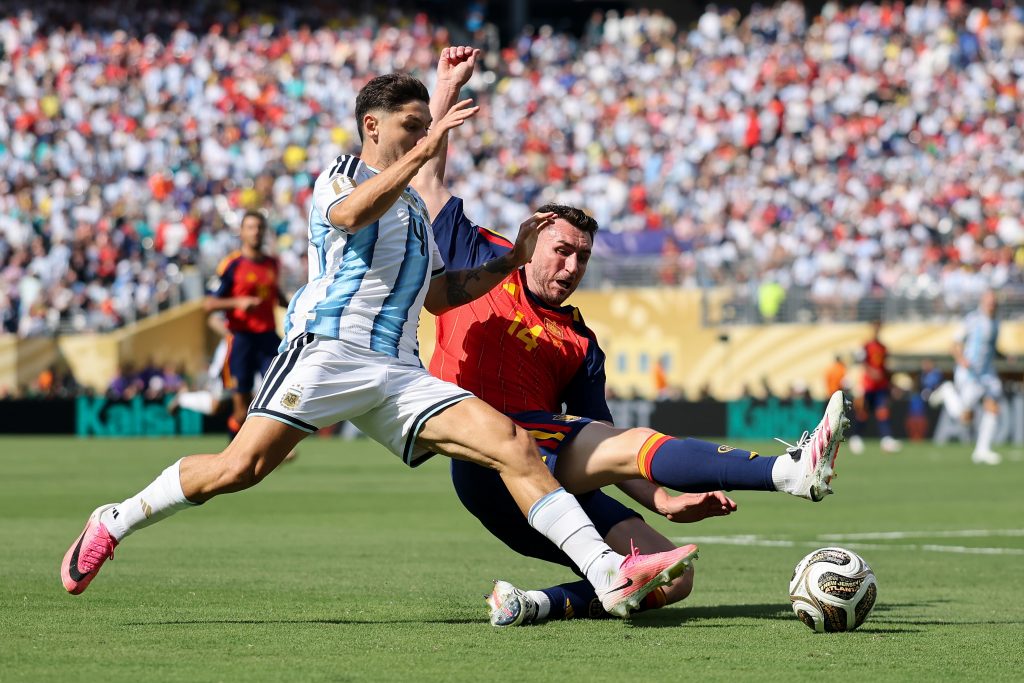
Regardless of any controversy, the 2026 World Cup was a success for Argentina. Granted, Lionel Scaloni’s side didn’t have the trickiest path, but won each of its first seven games to reach the final. Along the way, Argentina knocked out Cabo Verde, which proved a far trickier team than anyone could have anticipated, and completed late, dramatic turnarounds against Egypt and England. Only Spain, the defending Euros champions, prevented back-to-back titles.
However, make no mistake: over the past four years, Argentina has become worse. The statistics show otherwise. The 2022 team required two shoot-outs to win, but the current team didn’t go to penalties once. The defense was statistically worse in Qatar, as was the attack. Argentina’s only loss this summer came against Spain, which many tipped to win the whole tournament. In Qatar, the one loss came against Saudi Arabia. On paper, this current team is better. That isn’t the case.
Even though Lionel Messi is 39, Argentina upped its reliance on the star heavily this summer. There was no Ángel Di María, who for so long has been a valuable and reliable presence on the wing. Julián Álvarez, who was a breakout star in Qatar, had a tournament to forget outside of a remarkable goal vs Switzerland. Every game, the question was: can Messi bail out an unremarkable Argentina side again? Usually, the answer was yes.
Messi’s brilliance combined with the expanded World Cup format papered over many of Argentina’s flaws. In Qatar, Argentina faced Australia, the Netherlands, and Croatia on its way to the final, where Messi scored twice and beat the defending champions, France.
In North America, the run consisted of Cabo Verde, Egypt, Switzerland, England, and Spain. Each of those games was decided after the 90th minute. That’s weaker opposition, with more room for error, and the games were still close.
The England win was by far Argentina’s most convincing win against the best opposition. That game, though, was not necessarily won by Argentina, but instead lost by England. Thomas Tuchel took an entirely too defensive approach for far too long. It always seemed just a matter of time before England paid for this, and, in the 85th minute, Argentina pulled level through Enzo Fernández. Minutes later, Lautaro Martínez scored the inevitable winner.
Thanks to Tuchel’s defensive approach, Argentina was able to pepper the England goal with shots — 15, to be specific. In the first half, before England had taken the lead and gone on the defensive, it was a far more open game, and Argentina failed to create any real chances. After Anthony Gordon broke the deadlock, the South Americans had far more control and opportunities against a low block seemingly not interested in countering, and Argentina advanced to the final.
Spain was the first team with the quality and the bravery to go after Scaloni’s team for all 90 (or rather, 120) minutes. The result was a completely one-sided affair. Argentina didn’t muster its first shot until the 117th minute, at which point Spain already led 1-0. The team finished without a single shot on target, significantly less possession, and a deserved loss.
All it took for Argentina to exit was one quiet afternoon from Lionel Messi: the first time he failed to record a goal contribution, Argentina lost.
Throughout the tournament, Scaloni played an old and, frankly, flawed team. Four of Argentina’s starters for the final are at least 32. Nicolás Otamendi, who came off the bench, is 38, while fellow substitute Leandro Paredes is 32. The remainder of the players, with few exceptions, were either coming off injury-riddled seasons or were out of form. The youngest options, Valentín Barco and Nico Paz, barely sniffed the field.
Much of Argentina’s hopes for the future will rely on Paz. By the next World Cup, Messi will be 43 and almost certainly retired. Paz is not Messi — no one is — but he is the closest thing Argentina has to a replacement. At 21, Paz is technically gifted, and, like Messi, a left-footed player who can play on the right or centrally. This season, he recorded 12 goals and six assists in Serie A as Como qualified for the Champions League.
Amidst interest, Como paid €60 million, according to The Athletic, to remove Madrid’s buy-back and sell-on. He will once again play a key role for Cesc Fabregas’ side next season, but for Argentina, Paz was neglected. Granted, he didn’t blow anyone away in his cameos against Algeria and Jordan this summer, but the 21-year-old was an unused sub for each of Argentina’s five knockout games. He could have been valuable, certainly against Spain.
What Argentina needs to do now is prepare the next generation. The next Copa América happens in 2028. The focus, then, should be on bringing as many young players through to the national team as possible and developing and introducing the next stars. At this stage, Otamendi and Paredes have little to offer future Argentina teams, but players like Aarón Anselmino and Máximo Perrone do in their place.
The good news is that there is a promising group of young players coming through. Paz and Perrone are already starring for Como. Ex-River Plate stars Franco Mastantuono and Claudio Echeverri have underwhelmed following big moves to Real Madrid and Manchester City, respectively, but are still immensely talented. River goalkeeper Santiago Beltrán, too, could be a valuable player in a future without Emi Martínez.
That’s not to say that Argentina should force young players into the squad when they aren’t ready, or to ignore experience altogether. After all this time, Messi remains Argentina’s best player by some margin, and Martínez its best goalkeeper. Still, there needs to be big steps taken to develop and prepare the future, and to move on from the past. Teams that have failed to do this, like Germany, have paid for it dearly.
Whether coach Lionel Scaloni is the man to lead the team forward remains to be seen. Scaloni has done an incredible job, breaking Argentina’s trophyless streak with the Copa América in 2021, followed in quick succession by the Finalissima and the World Cup. However, he has come under fire this summer for his tactics, call-ups, and substitutions. Against Spain, Argentina was totally outplayed from the first minute.
In Argentina, Scaloni remains popular. However, his future is uncertain, and, with his contract winding down at the end of the year, it is very possible that both parties decide to move on. If that were to happen, there are some very interesting options, such as Javier Mascherano and Marcelo Gallardo.
Unlike many elite nations, La Albiceleste do not need to worry too much. The league continues to produce domestic talent that performs at a high level. There are dual-national options such as Paz, originally from Tenerife, Spain. There is good depth across the board, even in defense and in goal. And, as long as Lionel Messi is around, there is hope.
But Messi will not always be around. Argentina cannot depend on a 43-year-old Messi to hobble onto the field and carry them to glory in Saudi Arabia in 2030. This summer was the opposite of a disaster, but at the same time, it revealed some very pressing concerns. Should Argentina neglect to address these concerns once again, it will become a massive problem, and the team could join an ever-growing list of fallen international giants.
–
Image via @Argentina (X).