Manuel Neuer has come out of international retirement as Germany continues to be stuck in the past.
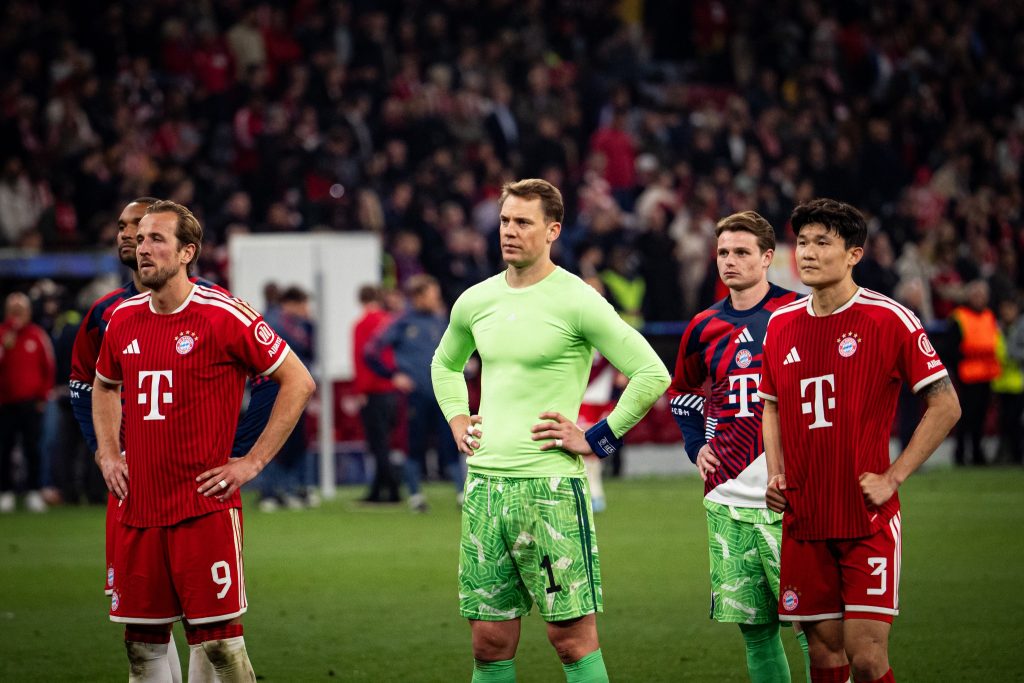
Make no mistake: Manuel Neuer is a legend of the game. The goalkeeper has played at the highest level for more than two decades. He’s won a World Cup, a treble, and a sextuple. He’s finished behind just Cristiano Ronaldo and Lionel Messi in the Ballon d’Or rankings when the duo were at the peak of their powers. Manuel Neuer revolutionized the position with his sweeper-keeper approach. And yet, he should not be selected for Germany this summer.
Neuer retired from Germany in August 2024 after the Euros. Oliver Baumann was projected to be in goal this summer. The Hoffenheim goalkeeper has enjoyed a strong season, helping his side qualify for the Europa League. Germany has no shortage of options in goal to call on, either. Freiburg’s Noah Atubolu, Bayern’s Jonas Urbig, and Stuttgart’s Alexander Nübel would have all been viable options.
Neuer, instead, who was limited to 22 Bundesliga appearances due to injuries and the rise of Urbig, will seemingly be in goal. While his season certainly hasn’t been as disastrous as some have claimed, Neuer lacks the world-class consistency he once had. An unbelievable performance at the Bernabéu in the Champions League was followed by poor showings at the Allianz Arena and Parc des Princes. Then, naturally, another brilliant performance at the Allianz Arena.
The thing is, it’s not just Neuer. Seemingly every time a major tournament comes around, Germany attempts to solve problems by scrambling for previous solutions. In 2024, that meant bringing Toni Kroos out of his international retirement for the Euros. Joachim Löw announced after the disastrous 2018 World Cup that Mats Hummels, Thomas Müller, and Jérôme Boateng were done with the national team. By the 2020 Euros, Hummels and Müller were back.
That’s not to say that none of those decisions made sense, or that they didn’t work out. Kroos, for instance, had a brilliant Euros and was coming off another remarkable season with Real Madrid. With the exception of the 2024 Euros, though, Germany has consistently underwhelmed in big tournaments post-2016. Sticking with the same generation of players isn’t going to magically change that. This also doesn’t help the DFB’s dual-nationality prospects.
Look at Germany’s team for this upcoming World Cup. The two first-choice goalkeepers, Neuer and Baumann, have a combined age of 76. Eight players are at least thirty years old, and, except Tah, Kimmich, and Baumann, none are coming off particularly inspiring seasons. Yet, it seems that the veterans are set to play a big role again this summer.
France was faced with a similarly interesting dilemma this year. Hugo Lloris, currently with LAFC, was reportedly interested in traveling to the World Cup this summer as France’s third-string goalkeeper. He would have been a strong addition, if not on the pitch. He’s a familiar character in the locker room, popular, and has experience. Instead, Didier Deschamps looked forward, selecting 21-year-old Robin Risser after a strong season with RC Lens. Risser will likely be at many World Cups to come.
That is why France, Argentina, Spain, and other teams have enjoyed so much success in recent years. Yes, all have had their fair share of veteran presences. But all have embraced their younger generations, and known when to move on from certain players. Spain had an inexperienced winger combination of Nico Williams and Lamine Yamal at the Euros, and beat Germany before winning the whole tournament.
Lionel Messi was obviously Argentina’s main man in Qatar, but Lionel Scaloni’s side would not have gone as far as they did if not for their young stars like Enzo Fernández and Julián Alvarez. The France team Argentina beat in the finals had won the World Cup four years earlier, with 19-year-old Kylian Mbappé starring for a young Les Bleus side.
And the previous winners: Germany. In 2014, Löw’s side won the World Cup, beating Argentina in the final. That was the last time Germany won a knockout stage game at the World Cup. That team had just three players 30 or older: Philipp Lahm, who was still a top-level right-back; Miroslav Klose, who still had a little left in the tank; and Roman Weidenfeller, there as a back-up to Neuer.
Look at the hero of the tournament for Germany. Mario Götze was only 22 when he came off the bench in the final versus Argentina, but that didn’t stop him from tucking the ball past Sergio Romero in extra time for the win. Many of the stars of 2014 were given chances as young players four years prior in South Africa, like Thomas Müller, Mesut Özil, and Neuer. That 2010 tournament set the groundwork for World Cup success in Brazil.
Manuel Neuer will not be the reason Germany loses the World Cup. He is, though, part of a greater problem. Germany has talented young players across the country and across the world. Not just young players, but players in their prime. Yet, Nagelsmann has stuck with familiarity, even when it doesn’t make sense. Leon Goretzka is projected to play a big role this summer, despite playing only a small role for Bayern. Felix Nmecha or Anton Stach would be much better options.
Yes, there are some young players in this team. Lennart Karl, for instance, is just 18. He provides an interesting option off the bench. However, it’s hard to ignore the snubs of players like Said El Mala, Urbig, or Tom Bischof. The rest of the sport has moved on, but it seems as though Germany is stuck in the past. There’s a reason that this team, historically one of the best national teams in the world, has failed to do much on a global stage over the past decade.
–
Photo via FC Bayern (Facebook).