While not uncommon in American sports, tanking hasn’t made it to the Premier League. Maybe that should change this season.
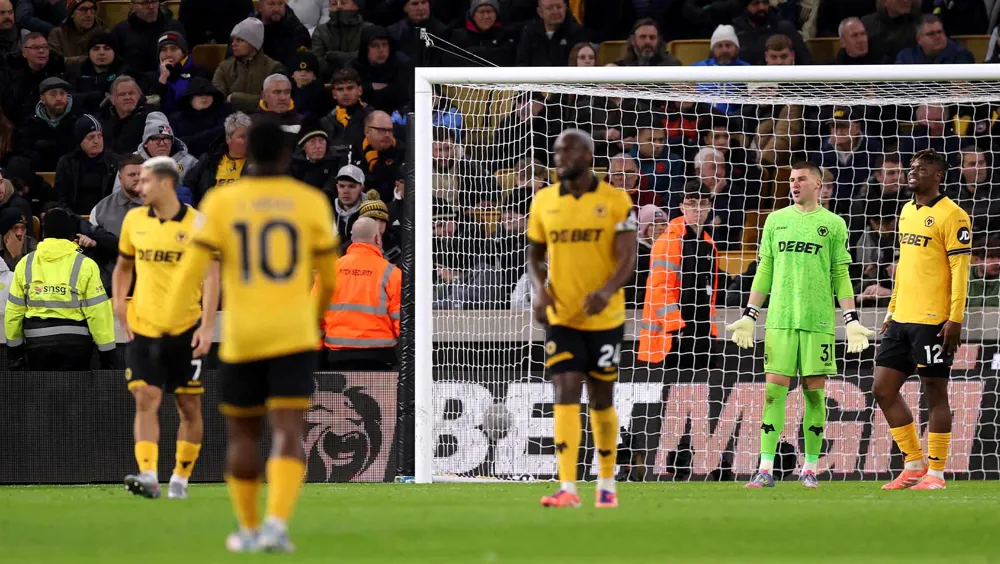
Let’s just get the obvious out of the way: Wolves are terrible.
Wolverhampton Wanderers, better known as Wolves, sit bottom of the Premier League. They have more Ws in their name than on the table, as they have yet to record a win this season. After fifteen games, Wolves have just two points and are currently on track to record the fewest points in Premier League history.
Thirteen points away from safety, it’s very unlikely that they will be able to claw themselves out of this mess.
Last season, manager Vítor Pereira and a miracle six-game win streak kept the club in the top flight. Pereira is gone now, as are star players Matheus Cunha and Rayan Aït-Nouri. Rob Edwards is in charge now — he replaced Pereira in November — and looks set for his second Premier League relegation. Not that it’s his fault, really — this team is a mess.
Now, Wolves could do everything possible to try to turn around their season in January. Bring in some new faces, make some big moves, and hope that risk pays off. Or, they could continue with their current team and hope Rob Edwards can pull off a great escape, which is extremely unlikely. Failing either of these could have potentially disastrous repercussions.
But there is a third option. Wolves can do something unique to American sports — embrace the suck, and tank.
Tanking is essentially losing on purpose. It’s not as obvious as fixing games or intentionally making bad decisions during games. Instead, teams field weak teams, trade off stars, and restock for future success, focusing on the future instead of the present.
This is especially common in the NBA or NFL, where teams throw a year or sometimes multiple years out the window to accumulate high picks in the yearly draft, and get better players.
The reason this doesn’t work in European leagues is that the risks are much higher, and the rewards are nonexistent.
There’s no draft, so the worst teams don’t get rewarded as they do in the US. It’s the opposite, in fact — the best players want to play at the highest level and sign for the best teams, so there’s no incentive to lose. On top of that, teams that lose enough games get relegated, which means massive financial losses and demotion.
There’s no real benefit to losing intentionally, then, but what if you are already losing?
I suggested this last January for Southampton, who were ten points from safety and unlikely to avoid relegation.
With players like Tyler Dibling and the soon-to-be free agent Kyle Walker-Peters in high demand, it felt like the ideal time to cash in. Instead, the Saints sold no players in the winter window, finished 26 points from safety, and did not get nearly what they wanted for their stars in the summer. This year, after a terrible start, they have recovered, but still sit mid-table in the Championship.
Tanking, in this instance, is pretty simple — if not quite the same as tanking in American sports. Think of it more as a team accepting its fate and trying to best prepare for future success. Sell off as many key players, especially those who are not willing to drop down a division, as you can in January, taking advantage of the increased demand in the winter transfer window.
Then, spend as little as possible on replacements, but ideally, players who have something to prove still, so the club doesn’t get completely embarrassed on the field. The idea behind this is to give the club as much time and resources to prepare for life in the Championship next season.
First, the selling. In the summer, a fire sale is always inevitable for relegated teams. Championship clubs can’t afford Premier League salaries, and Premier League players don’t want to drop down to the second flight.
This means clubs lose all their leverage in the market and often end up selling for significantly less than they would have hoped. Southampton, for instance, had to settle for just €40 million from Everton this summer for Tyler Dibling after a much higher reported price tag in the winter.
What Wolves can do is flip the script and take advantage of the desperation in the January window.
The winter window is notorious for panic buys. Few teams want to lose their best players midseason, and teams competing for titles, European qualification, or themselves are fighting relegation are desperate to bring in new players. Even usually smart clubs make big mistakes in January.
Last season, struggling Manchester City dropped more than €200 million in January, notably spending €75 million on in-form Frankfurt forward Omar Marmoush. Or look at when Bayern Munich, desperate for a right-back, ended up spending €30 million on Galatasaray’s Sacha Boey in January 2024. Suffice to say, they wouldn’t do the same in hindsight.
There are a few players in Wolverhampton’s squad, such as Brazilian midfield duo João Gomes and André, who would have more than a few interested suitors. Selling now maximizes their values, and Wolves can bring in players who will be prepared to help them return to the top flight next season.
Of course, even if they sell all their stars, Wolves still have to finish the season, and nobody wants to be the team that takes the record points tally from Derby County. The obvious solution is to bring in players with potential and resale value, but at this stage, it’s unlikely that many young players would want to take that risk.
So, part two of the tanking process: bringing in aging stars with little to lose.
Free agents like Sergio Reguilón or Emmanuel Dennis. Players like Wataru Endō, James Ward-Prowse, or Fabian Schär, who are barely playing or are unhappy with their minutes. Players who are out of contract next summer, and can move in January for little or nothing. Combine this with some promotions from the reserves and academy who can maybe help the team in the long-term.
The goal is to field a team that costs very little, but doesn’t completely roll over and die or look completely out of its depth. A team with experience and a chip on its shoulder that will put up a fight in every game, pick up a win or two, and maybe even not be the worst team in Premier League history.
Rob Edwards is under no pressure, then, and gets to focus on what really matters — preparing to get Wolves back into the Premier League next season.
It’s as close to a win-win as you can get in this scenario. The players get one last chance to show they can hack it in the Premier League and potentially earn one last big move. Maybe some are good enough to stick with Wolves in the Championship next season and help fight for promotion. Maybe some can be flipped for a decent profit at the end of the season.
At worst, they put up a respectable fight, which is no worse than what the current, far more expensive side is doing.
(Which brings up another point — a big criticism of tanking usually is how the fans react, which any Philadelphian will tell you is valid. Losing is not fun. However, morale is already at rock bottom for Wolves fans, who are frustrated with the owners, and right now, they still can’t get results on the pitch. If anything, this version of losing should have fans more optimistic than the current losing strategy.)
The big sales allow Wolves to prepare for life in the Championship — something easier said than done for relegated teams. The signings are just to keep things from being entirely negative.
–
If you still think this is an outrageous idea, here are a few stats for you to show just how bad Wolves are this season.
According to Transfermarkt, Wolverhampton have the second-worst start in Premier League history after 15 games. Only Portsmouth did worse in the 2009/10 season. They still had three wins, but sat on one point after being docked nine points for going into administration.
Wolves currently average 0.53 goals per game and 2.2 goals against per game. No player in the squad has more than one goal, while Manchester City’s Erling Haaland and Brentford’s Igor Thiago each have more goals than the entire Wolves team put together.
Wolves already have a worse goal differential than 17 of the 20 Premier League teams last season. All three with worse records — Leicester City, Ipswich Town, and Southampton — were relegated.
The worst season in Premier League history was Derby County’s infamous 2007/08 season, when the Rams finished with eleven points. If Wolves keep picking up points at their current pace, they will finish with five.
Wolves have lost their last eight consecutive Premier League games, scoring in just two of those. Their next four games before January: Arsenal (away), Brentford (home), Liverpool (away), Manchester United (away). Not exactly a cakewalk.
So, things are already bad, and it could get even worse.
–
Even in the American leagues like the NFL, where losing is rewarded, tanking remains a very controversial subject. There’s something so unethical about choosing to field a team that’s not particularly competitive.
But what’s the alternative here? Wolves have steadily worsened, and it’s not a fair playing field, anyway. Matheus Cunha practically single-handedly kept Wolves in the Premier League last year, only for Manchester United to sign the Brazilian in the summer. Aït-Nouri was off to Manchester City, too, and every star Wolves have developed recently has been sold on.
At the moment, relegation seems inevitable, and it’s bound to be a memorable one as they fight not to be the worst team in Premier League history. If they don’t get some results by the end of December, maybe it’s best for Wolves if they just embrace it and put themselves in the best possible position for next season.
–
Image via wolves.co.uk.


1 thought on “Can a Premier League Team Tank? Wolves Should Consider It”